Minimalist Small Bedroom Layout for Working From Home
The bedroom was never designed to be a workplace. It was designed to be the one room in a home where the demands of the outside world don’t follow you, where your nervous system can genuinely decompress, and where the transition from waking life to sleep happens naturally and without friction. When you introduce a desk, a monitor, a keyboard, and all the visual noise of an active workstation into that space, you create a tension that the room was never meant to hold.
And yet for millions of people living in Indian cities, in studio flats, in PG rooms, and in compact apartments where a dedicated home office simply isn’t an option, the bedroom is the workplace. The question is not whether to combine these two functions but how to do it in a way that serves both without destroying either. A minimalist approach to the layout offers the most effective answer to this problem. By reducing the number of objects in the room, clarifying the purpose of each zone, and making deliberate decisions about every piece of furniture and every surface, it becomes possible to create a bedroom that functions as a focused workspace during the day and a genuinely restful sleeping environment at night.
Principles of a Minimalist Small Bedroom Layout for Working From Home
Before getting into specific layout ideas, it helps to understand the principles that make minimalism particularly effective in a combined bedroom and workspace.
The first principle is visual separation. The brain responds to visual cues about context and purpose. When the bed and the desk are in the same line of sight, the brain struggles to fully commit to either working or resting because both demands are present simultaneously. A minimalist layout uses furniture placement, rugs, curtains, and lighting to create clear visual zones that help the brain understand which mode it should be in at any given time.
The second principle is surface discipline. In a small bedroom that also functions as a workspace, every horizontal surface becomes a potential dumping ground for work materials, personal items, and the general accumulation of daily life. A minimalist approach keeps surfaces clear and intentional, which reduces the visual noise that makes small spaces feel chaotic and makes it genuinely difficult to shift mentally from work mode to rest mode at the end of the day.
The third principle is functional sufficiency. Every piece of furniture and every object in a minimalist bedroom should earn its place by serving a clear and necessary purpose. Decorative items that don’t also serve a functional role are kept to a minimum. Furniture that serves only one purpose is replaced wherever possible with pieces that serve two or three. The result is a room that contains exactly what is needed and nothing more, which in a small space creates a sense of calm and spaciousness that a cluttered room of the same dimensions simply cannot achieve.
Minimalist Small Bedroom Layout Ideas for Working From Home
1. The Corner Desk Setup
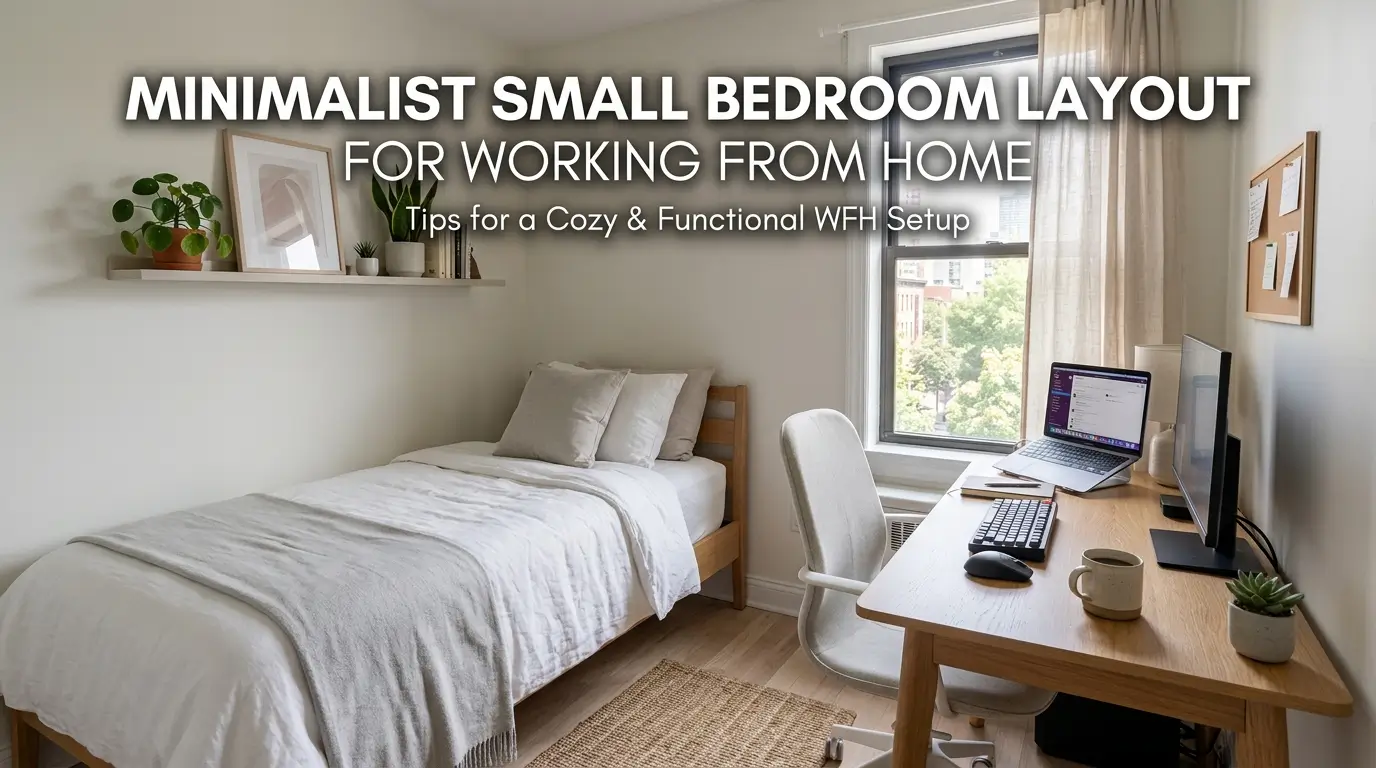
Placing the desk in a corner of the bedroom is one of the most space-efficient and acoustically sensible layout decisions available in a small room. A corner desk uses wall space on two sides simultaneously, giving you more working surface than a straight desk of the same footprint while keeping the center of the room clear and open.
From a minimalist perspective, the corner placement also helps contain the visual presence of the workspace. When the desk is tucked into a corner, the work zone has a natural boundary that keeps it from visually dominating the room. Facing the desk into the corner rather than out toward the room means that when you’re working you’re looking at a focused, contained workspace rather than your bed, and when you’re in bed you’re not looking directly at your desk and everything on it.
Keep the desk surface strictly minimal. A monitor or laptop, a small lamp, a single organizer for essential stationery, and nothing else. Every item that sits on the desk surface is a visual reminder of work that is visible from the bed, so the discipline of keeping that surface clear at the end of the working day is one of the most important habits you can build in a combined bedroom and workspace.
2. Bed Placement as the Room’s Anchor
In a minimalist small bedroom, the bed is the largest piece of furniture and the one that most fundamentally determines the layout of everything else. Placing it correctly relative to the workspace is the most important single decision in the entire room design.
The most effective arrangement in a small room is to place the bed against the wall furthest from the desk, with the desk in the opposite corner or along an adjacent wall. This maximizes the physical and visual distance between the two zones and makes the separation between them feel as clear and definitive as possible within the constraints of the space.
Avoid placing the bed directly facing the desk so that the first thing you see when you wake up is your workstation. This arrangement is one of the most common causes of the kind of low-level work anxiety that makes it difficult to sleep well in a room that doubles as an office. The goal is for the bed to face something calm and visually quiet — a window, a plain wall, or a simple piece of art — rather than a monitor and a pile of work materials.
3. A Dedicated Work Wall
Rather than scattering work-related furniture and storage across the room, consolidating everything work-related onto a single wall creates a clear and containable work zone that can be visually closed off at the end of the day. A desk, a shelf above it for books and work materials, and a small set of drawers beside it can all be arranged along one wall to create a self-contained working environment that occupies a defined portion of the room without spreading its visual influence across the rest of it.
This dedicated work wall approach works particularly well in combination with a curtain that can be drawn across the entire wall at the end of the working day. When the curtain is open, the work zone is active and functional. When it is closed, it disappears completely and the room reverts to a bedroom. This is one of the most psychologically effective strategies available for managing the tension between working and sleeping in the same space, and it requires nothing more than a ceiling-mounted curtain track and a set of heavy curtains.
4. Floating Shelves Instead of Bulky Storage
Bulky wardrobes, large chest of drawers, and oversized storage units are the enemies of a minimalist small bedroom. They take up floor space, create visual weight, and make the room feel smaller and more oppressive than it needs to be. Floating wall shelves replace floor-standing storage with wall-mounted solutions that keep the floor clear and make the room feel significantly more open and spacious.
Above the desk, a single floating shelf holds books, a small plant, and work-related materials that you need accessible but don’t want cluttering the desk surface. Beside the bed, a small floating shelf serves as a bedside table without occupying any floor space at all. Along one wall, a series of floating shelves at varying heights provides wardrobe overflow storage for folded clothes, accessories, and personal items that would otherwise require a large piece of freestanding furniture.
The visual lightness of floating shelves is as important as their spatial efficiency. Because they sit against the wall with nothing beneath them, they allow the eye to travel across the floor uninterrupted, which creates a perception of space that floor-standing furniture blocks completely.
5. Murphy Bed for Maximum Daytime Space
If the bedroom is truly small and the work demands are significant enough to require a proper desk setup rather than a compact corner arrangement, a Murphy bed is the most transformative layout solution available. During working hours the bed is folded into the wall, freeing the entire floor area of the room for an uncompromised workspace. At the end of the working day the desk is cleared, the bed is folded down, and the room becomes a bedroom with no trace of the office it was a few hours earlier.
Modern Murphy bed systems designed for Indian apartment dimensions are available from furniture brands in most major cities and can be custom-built by local carpenters at reasonable cost. Many systems incorporate a fold-down desk into the same wall unit so that when the bed is up the desk is down, and when the bed is down the desk folds away. This mechanical separation of the two functions is the most complete solution to the bedroom-office tension available in a small space, because it makes it physically impossible for both zones to exist simultaneously.
6. Lighting Zones for Work and Rest
Lighting is one of the most powerful and most underused tools available for managing the transition between work mode and rest mode in a combined bedroom and workspace. The overhead light serves neither function particularly well — it is too bright and too flat for comfortable relaxing and often the wrong color temperature for focused work. Replacing the single overhead light with a layered lighting system that serves each zone specifically makes an enormous difference to how the room functions at different times of day.
A focused, adjustable desk lamp with a cool or neutral color temperature supports concentration during working hours. A warm, dimmable bedside lamp creates the kind of soft, low-light environment that signals to the brain that the working day is over and rest is approaching. Warm fairy lights above the bed or along the headboard wall add a layer of ambient warmth that reinforces the restful identity of the sleeping zone. By using only the desk lamp during working hours and only the warm bedside and ambient lights during the evening, you create two distinctly different lighting environments within the same room that help the brain shift between modes more effectively than any physical divider.
7. Neutral Color Palette with Deliberate Accents
Color has a direct and well-documented impact on mood, energy levels, and cognitive performance. In a minimalist bedroom that also functions as a workspace, the color palette needs to support both focused work and restful relaxation simultaneously, which is a genuinely difficult balance to achieve with strong or saturated colors.
A neutral base palette of whites, warm greys, soft beiges, and muted earthy tones creates a calm, visually quiet environment that supports both work and rest without pushing strongly in either direction. Within this neutral base, deliberate accents of a single color — a terracotta cushion, an olive green plant pot, a warm wood desk surface — add personality and warmth without creating the kind of visual stimulation that makes a room feel energizing when you need it to feel calm.
Avoid using bright, saturated colors on the walls in a small bedroom that doubles as a workspace. They create a level of visual stimulation that works against the restful quality the space needs to maintain. If color on the walls is important, choose muted, desaturated versions of your preferred hues that add character without adding energy.
8. Closed Storage Over Open Storage
In a minimalist small bedroom, the discipline of closed storage is one of the most important layout principles available. Open shelves and visible storage create a constant low-level visual noise from the objects stored on them, even when those objects are neatly organized. Closed storage — drawers, cupboards, boxes with lids, baskets with covers — conceals that visual noise entirely and allows the room to maintain a sense of calm clarity that open storage consistently undermines.
For the workspace, closed drawers rather than open desktop organizers keep work materials out of sight when the working day ends. For the sleeping zone, a bed with built-in drawer storage or hydraulic lift storage keeps extra bedding, clothing, and personal items completely out of view. For general room storage, a single wardrobe with doors that close fully is acoustically and visually cleaner than an open shelving system of the same capacity.
The principle is simple. If you can see it, it occupies mental space. If it is hidden behind a closed door or a drawer front, it doesn’t. In a small bedroom where mental space is as limited as physical space, closed storage is one of the most effective tools available for maintaining the sense of calm that a minimalist layout depends on.
Putting the Layout Together
The most effective minimalist small bedroom layout for working from home is not a single specific arrangement but a set of decisions made consistently according to the principles described above. Place the desk in a corner or against a dedicated wall, away from the direct sightline of the bed. Keep the desk surface clear and store work materials in closed drawers or behind a curtain at the end of each working day. Use lighting deliberately to create two different environments in the morning and the evening. Choose a neutral color palette that supports both focus and rest. Replace floor-standing storage with floating shelves wherever possible. And commit to the discipline of keeping every surface clear of the accumulated clutter that gradually erodes the calm that a minimalist layout is designed to create.
A Room That Works as Hard as You Do
A minimalist small bedroom that functions as a home office is not a compromise. It is a design solution that, when executed with care and consistency, creates a space that supports focused work during the day and genuine rest at night without sacrificing either. The key is intention — every decision about what goes into the room, where it sits, and what purpose it serves should be made deliberately rather than by default. A room designed with that level of intention, regardless of its size, will always perform better than one that simply accumulated furniture and objects over time without any clear sense of what the space was supposed to do or feel like.