Tiny Entryway Organization and Decor Ideas
The entryway is the first thing you see when you come home and the last thing you experience before you leave. In an ideal world it is a space that sets a welcoming tone, keeps the chaos of daily life organized, and creates a clear psychological transition between the outside world and your personal space. In reality, for most people living in Indian apartments and compact urban homes, the entryway is a narrow strip of floor just inside the front door that collects shoes, bags, keys, umbrellas, and every other item that gets dropped the moment someone walks through the door. It is simultaneously one of the most used and most neglected spaces in the entire home.
The challenge is that entryways in Indian flats are almost universally tiny. A one or two foot wide corridor, a small landing, or simply the area immediately inside the front door is all that most apartments provide as a transitional space between the outside and the inside. There is rarely room for the kind of generous entryway furniture — a large console table, a full-length mirror, a bench with storage — that interior design references typically suggest. And yet the entryway’s function is critical enough that leaving it unaddressed creates a daily friction that spreads into the rest of the home in the form of misplaced keys, cluttered floors, and the low-level stress of a space that never quite feels under control.
The solution is not to wish for more space. It is to use the space that exists with a level of intentionality and specificity that transforms even the most minimal entryway into a space that functions beautifully and makes a strong first impression on everyone who walks through the door.
Tiny Entryway Organization and Decor Ideas
1. Wall-Mounted Shoe Rack Instead of a Floor Unit
Shoes are the defining organizational challenge of an Indian entryway. The cultural norm of removing shoes before entering the home means that the area just inside the front door accumulates footwear at a rate that a tiny entryway simply cannot absorb if the storage solution involves placing shoes on the floor. A floor-standing shoe rack in a narrow entryway occupies precisely the floor space that the entryway can least afford to give up and makes the area feel cluttered and cramped from the moment you walk in.
A wall-mounted shoe rack solves this problem directly and completely. Mounted on the wall at an appropriate height, it holds a significant number of pairs without touching the floor at all. The floor beneath it remains clear, which makes the entryway feel larger, easier to clean, and more open than a floor-standing alternative of the same capacity would ever allow. Tilted wall-mounted racks that hold shoes at an angle are particularly space-efficient because they use the depth of the shoe itself rather than requiring a full horizontal shelf for each pair. They are available from home stores and online platforms across India at very accessible price points and can be installed with basic wall anchors in under an hour.
For a rental situation where wall mounting is not an option, an over-door shoe organizer hung on the back of the front door holds a surprisingly large number of pairs in a completely floor-free installation that requires no drilling and no landlord approval.
2. A Multi-Function Command Station
The most common daily frustration associated with the entryway is the misplacement of small essential items — keys, wallets, phone chargers, transit cards, and the various other things that need to be grabbed on the way out the door every morning. The solution is a dedicated command station mounted on the entryway wall that gives each of these items a specific, consistent home that becomes automatic through habit.
A simple wall-mounted organizer that combines a key hook, a small shelf for wallets and phones, and a slot or tray for mail and documents creates a command station that costs very little but eliminates a specific daily friction that most people living in small apartments deal with every single morning. In India where the front door area often handles the receipt of deliveries, bills, and documents as well as the daily departure and return ritual, having a dedicated surface for these items prevents them from migrating to the kitchen counter or the dining table where they create clutter in a more visible and more disruptive location.
A small corkboard or magnetic board above the command station shelf adds a surface for notes, reminders, and the small pieces of paper that would otherwise get lost. The entire installation can be achieved with command strips and adhesive hooks in a rental situation, requiring no drilling and leaving no permanent marks.
3. Vertical Coat and Bag Storage
In a tiny entryway, a freestanding coat rack is rarely a viable option because it occupies floor space that doesn’t exist. A row of wall-mounted hooks arranged vertically or in a compact horizontal line takes up a fraction of the space and does the same job more efficiently. Hooks at varying heights — taller hooks for jackets and bags, lower hooks for children’s items or smaller accessories — maximize the utility of a small section of wall while keeping the floor completely clear.
In the Indian context where the entryway also needs to handle dupattas, stoles, helmets, backpacks, and the various other items that come off the body on entering the home, a generous row of hooks is one of the highest-utility installations you can make in any entryway regardless of its size. Choose hooks with a weight rating appropriate for the heaviest items you plan to hang — a motorcycle helmet and a heavy backpack together put significant load on a wall hook — and install them into wall studs or with appropriate anchors for a secure, permanent installation.
4. A Slim Console Table or Floating Shelf
A console table in a tiny entryway sounds like exactly the kind of furniture that a small space cannot accommodate, and in its standard form that is true. But a genuinely slim console table — one that projects only six to eight inches from the wall — provides a surface for keys, a lamp, decorative objects, and daily essentials without meaningfully reducing the floor clearance in the entryway corridor. In a slightly wider entryway, even this modest piece of furniture transforms the space from a bare landing into something that feels intentional and designed.
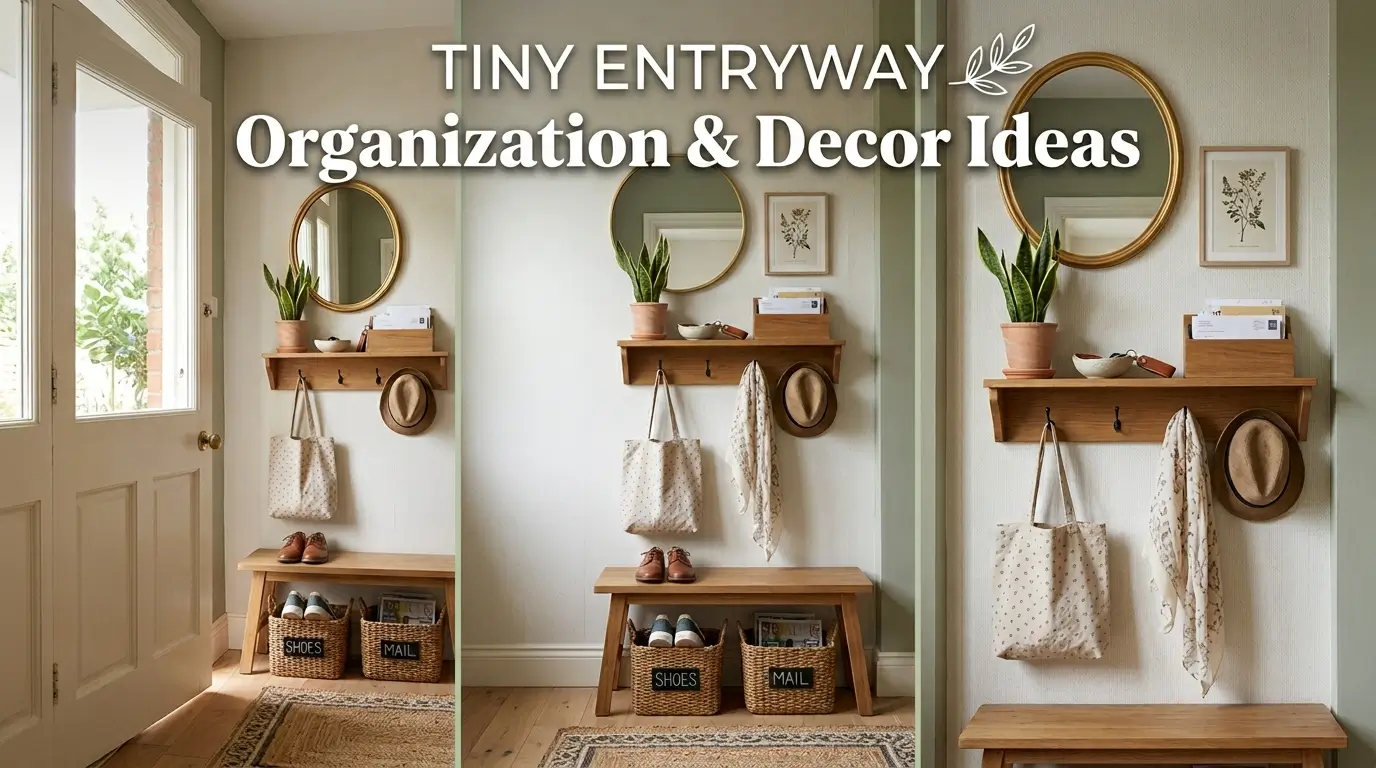
Where even a slim console table is too much for the available floor space, a floating shelf at approximately waist height serves an identical purpose with zero floor footprint. A single floating shelf with a few hooks beneath it combines the surface function of a console table with the hanging function of a coat rack in a single wall-mounted installation that takes up no floor space at all. This combination — shelf above, hooks below — is one of the most space-efficient and versatile entryway solutions available for genuinely tiny spaces and is achievable in any Indian apartment for a very modest investment in materials and installation.
5. Mirror to Open Up the Space
A mirror in a tiny entryway does several things simultaneously. It gives you a surface for a final appearance check before leaving the house, which is a genuinely practical function that an entryway is well positioned to serve. It reflects light from the front door or from an entryway light fixture, making a narrow, often dark corridor feel brighter and more welcoming. And it creates the perception of additional depth that makes a tiny space feel less confining and more generous than its actual dimensions allow.
In a very narrow entryway where a full-length mirror on the wall might feel overwhelming, a tall narrow mirror or a round mirror at eye level achieves the light-reflecting and space-amplifying benefits without dominating the wall. In slightly larger entryway situations, a full-length mirror leaned against the wall or mounted on the back of the front door provides the practical function of a dressing mirror while opening up the space visually in a way that no other single decorative addition can quite replicate.
6. Umbrella and Helmet Storage Solutions
Umbrellas and helmets are two of the most physically awkward items to store in a tiny Indian entryway. Umbrellas drip after use, take up floor space when stood upright, and tend to end up leaning against the wall in a way that looks messy regardless of how organized everything else in the entryway is. Helmets are bulky, heavy, and have no natural place to live in a small space.
A wall-mounted umbrella holder — a simple bracket or hook system that holds one or two umbrellas flat against the wall — solves the umbrella problem without requiring any floor space. A drip tray placed beneath it catches the water from wet umbrellas and keeps the floor dry. For helmets, a large, sturdy hook mounted at the right height holds a motorcycle or bicycle helmet securely against the wall where it is immediately accessible on the way out the door without occupying any shelf or floor space. In a household with multiple helmets, a dedicated helmet shelf — a simple floating shelf wide enough to hold two helmets side by side — keeps them organized and off the floor in a clean and intentional-looking way.
7. Lighting That Sets the Tone
The entryway light in most Indian apartments is a single overhead fitting that provides adequate but completely uninspiring illumination. Upgrading the entryway lighting, or adding a secondary lighting layer, is one of the most impactful and most affordable ways to transform how the space feels without changing anything structural about it.
A small wall sconce beside the front door or a plug-in lamp on a console shelf creates a warm, welcoming pool of light that makes coming home feel like an arrival rather than an entry into a functional corridor. Warm white bulbs in the 2700 to 3000 Kelvin range create the most welcoming and residential atmosphere for an entryway. If the entryway has no power point nearby, battery-operated LED wall sconces or rechargeable puck lights mounted on the wall provide warm ambient lighting without requiring any electrical work.
The quality of light in an entryway is something that every person who enters the home registers immediately, often without consciously identifying it. A well-lit entryway with warm, ambient light communicates care and intentionality in a way that the best-organized entryway under a harsh overhead fluorescent light simply cannot.
8. A Small Plant or Fresh Flowers
A single plant or a small vase of fresh flowers in the entryway introduces life and color into what is often one of the most visually bare areas of an Indian home. It signals to everyone who enters that the space has been thought about and cared for, which sets a tone for the rest of the home that extends beyond the entryway itself.
In a tiny entryway where surface space is limited, a small potted plant on a floating shelf, a trailing plant in a wall-mounted planter, or a bud vase with a single stem on the command station shelf is all that is needed to achieve this effect. Low maintenance plants that tolerate low light and irregular watering — pothos, snake plants, and ZZ plants are ideal — work best in an entryway context where the light levels are often insufficient for more demanding varieties. Fresh flowers need not be an expensive habit in India where marigolds, tuberoses, and seasonal blooms are available at remarkably low cost from local flower vendors in virtually every city and town.
9. Dedicated Spot for Delivery and Mail
In Indian apartments where deliveries arrive frequently and the postman or courier person expects items to be received and signed for at the door, the entryway needs a specific solution for the management of incoming mail, packages, bills, and documents that prevents them from immediately migrating to the kitchen counter or the dining table where they create clutter in a more disruptive location.
A small wall-mounted mail organizer with two or three slots — one for immediate action items, one for bills and documents to be filed, one for items that belong to other household members — installed beside the front door gives incoming paper items a specific home the moment they enter the house. A small basket or tray on the floor or a low shelf beside the door handles small packages and deliveries that need to be processed or unpacked. These simple additions eliminate one of the most common sources of clutter migration in Indian homes and keep the chaos of daily life contained within the entryway rather than allowing it to spread throughout the flat.
10. Keep It Intentionally Minimal
The final and perhaps most important idea for a tiny entryway is the discipline of keeping it deliberately minimal. Every item that lives permanently in the entryway should earn its place through daily use or genuine necessity. The entryway is not a storage overflow zone for items that don’t have a home elsewhere in the flat. It is a transitional space with a specific set of functions, and every object that doesn’t serve one of those functions makes the space harder to use and harder to maintain.
In a tiny entryway, the difference between a space that works and one that doesn’t is often just a few items too many. A pair of shoes that should be in the wardrobe, a bag that should be hung up rather than dropped on the floor, a pile of mail that should have been sorted a week ago — these small accumulations compound quickly in a tiny space and erode the functionality and visual calm that make a well-organized entryway worth having. The habit of putting things in their designated place every time, and of regularly reviewing what lives in the entryway and whether it deserves to remain there, is the maintenance practice that keeps all of the organizational solutions on this list working over time rather than gradually being overwhelmed by the natural entropy of daily life.
Designing Your Entryway as a Complete System
The most effective tiny entryway is not the result of a single good idea but of several good ideas working together as a deliberate system. Wall-mounted shoe storage keeps the floor clear. A command station keeps daily essentials organized and accessible. A mirror opens up the space visually. A slim shelf or console provides a surface for arrivals and departures. Warm lighting sets a welcoming tone. A plant brings life and color. Each element serves a specific function and together they create an entryway that is organized, attractive, and genuinely easy to maintain.
Making Your Entryway Work Every Single Day
A well-organized tiny entryway is not a luxury that only larger homes can afford. It is a practical necessity for anyone who wants their home to function smoothly from the moment the front door opens. The ideas in this list are achievable at modest cost, compatible with rental restrictions, and scalable to the specific dimensions and constraints of virtually any Indian apartment entryway. The investment in getting this space right pays daily dividends in the form of mornings that run more smoothly, homes that feel more organized, and the quiet satisfaction of a space that does exactly what it is supposed to do every single time you walk through the door.