Maximalist Mirror Wall Ideas for Small Rooms
Maximalism and small rooms are not natural allies in the conventional understanding of interior design. The dominant logic of small space design has always pushed in the opposite direction — toward restraint, toward minimalism, toward the discipline of having less so that the space can feel like more. This logic is not without merit. A small room filled with too many competing objects, too many patterns, and too many surfaces demanding attention simultaneously does feel smaller and more chaotic than one that has been edited with a careful hand. The standard advice to keep it simple, keep it light, and keep it sparse has genuine spatial reasoning behind it.
But maximalism is not chaos. It is not the thoughtless accumulation of objects without regard for how they relate to each other and to the space they occupy. True maximalist design is a highly deliberate practice — a commitment to richness, to layering, to the idea that more can genuinely be more when the more is curated, considered, and composed with as much care as the most rigorous minimalist exercise. And within the maximalist toolkit, mirrors occupy a unique position because they are one of the few decorative elements that simultaneously add visual complexity and create the perception of more space rather than less.
A maximalist mirror wall in a small room does something that no other design approach can quite replicate. It multiplies the visual richness of the space rather than adding to it linearly — every mirror reflects the room back on itself, the reflections of other mirrors create infinite visual depth, and the layered, complex visual environment that results feels simultaneously more elaborate and more spacious than the actual dimensions of the room allow. It is, in the most literal possible sense, the most expansive design gesture available within a small space, and when it is executed with genuine maximalist intention it transforms a small room from a constraint to be managed into a jewel box of visual complexity and reflected light.
Maximalist Mirror Wall Ideas for Small Rooms
1. Gallery Wall of Mismatched Vintage Mirrors
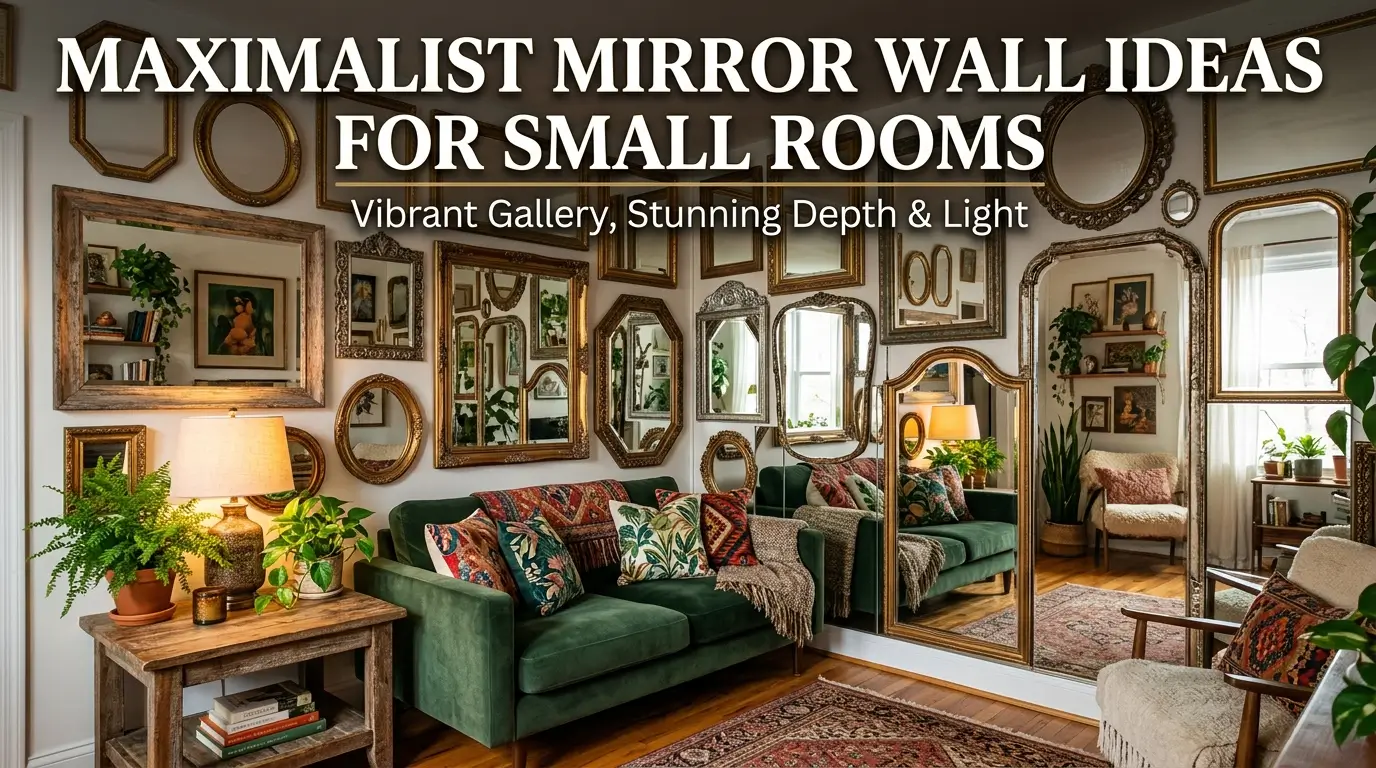
A gallery wall composed of mismatched vintage mirrors in varying shapes, sizes, frames, and finishes is the most classically maximalist mirror wall composition available, and it is also the most personally expressive because every piece is different, every piece has its own history, and the arrangement as a whole reflects a curatorial sensibility that cannot be purchased off a shelf as a matched set.
The fundamental principle of a vintage mirror gallery wall is productive inconsistency. Round mirrors beside rectangular ones, ornate gilded frames beside plain dark wood, beveled mirror glass beside plain float glass, large statement pieces beside small accent mirrors — the variety of the individual elements is what gives the composition its richness and its visual energy. But variety without structure becomes chaos, and the structure that holds a maximalist gallery wall together is provided by a unifying element that runs through all the individual pieces — a consistent metal tone across all the frames, a family of related finishes, a shared color in the patina of different frame materials, or simply the quality of age and history that genuine vintage pieces tend to share.
In an Indian context, vintage mirrors are available from antique dealers, Sunday markets, and heritage furniture shops in most major cities. Old teak-framed mirrors, brass-inlaid rectangular mirrors, carved wooden frames from decommissioned havelis, and ornate Rajasthani mirror-work frames are all available at price points that reflect their age and provenance rather than any premium for being in fashion. Mixing these genuinely old pieces with new mirrors in complementary styles creates a gallery wall that has the depth and authenticity of a collection built over time rather than assembled in an afternoon.
2. Floor-to-Ceiling Mirrored Wall Panel
A single floor-to-ceiling mirrored wall — one entire wall of a small room covered in mirror glass from the floor to the ceiling — is the most spatially transformative mirror installation available and one of the most dramatically maximalist in terms of its visual impact. It does not add objects to the room. It doubles the room. Every element — every piece of furniture, every decorative object, every person in the space — appears twice, the room seems to extend indefinitely beyond the mirror wall, and the light from windows and lamps is reflected and amplified to a degree that makes the room feel luminous rather than enclosed.
This is an approach that maximalist Indian interior design has used in specific contexts — traditional Indian palaces and havelis used mirrored interior surfaces extensively in the Sheesh Mahal tradition, where mirror-tiled walls and ceilings created environments of extraordinary reflected complexity — and that contemporary maximalist design has adopted in a more edited and architecturally considered form. A full mirrored wall in a small bedroom, living room, or dressing area uses the same fundamental principle that those historic mirror rooms employed — the amplification of light and the multiplication of visual depth through large-scale reflective surface — in a form that is practical and accessible in a contemporary apartment context.
The practical installation of a floor-to-ceiling mirrored wall involves either large mirror panels fixed directly to the wall surface with appropriate adhesive and mechanical fixings, or a frameless glass installation by a specialist glazier. Both options are available through mirror suppliers in Indian cities at reasonable rates, and the result justifies the investment through the daily experience of a room that feels dramatically larger and more luminous than its actual dimensions.
3. Moroccan and Geometric Mirror Tile Arrangements
Moroccan mirror tiles — small pieces of mirror glass cut into geometric shapes and arranged in star, hexagonal, or interlocking pattern formations — create a maximalist wall surface of extraordinary visual complexity that references one of the oldest and most sophisticated traditions of decorative mirror work in the world. The mosaic quality of the arrangement, with its hundreds of individual mirror pieces each reflecting light at a slightly different angle, creates a surface that shimmers and shifts with every movement in the room, responding to changes in light and movement in a way that no single large mirror can replicate.
The effect of a Moroccan mirror tile wall in a small room is fundamentally different from the effect of any other mirror treatment. Rather than reflecting a clear, coherent image of the room — as a single large mirror or a flat mirrored wall does — the mosaic of small tiles breaks the reflection into fragments that create a dazzling, faceted quality of reflected light that is more like standing near water in sunlight than looking into a conventional mirror. The room is present in the reflection but it is abstracted and multiplied, creating a visual environment of extraordinary richness that the eye never fully resolves and therefore never fully stops finding interesting.
Indian craft traditions include their own versions of this mirror mosaic technique — the Lippan work of Kutch, which embeds mirror pieces in a mud and clay ground in geometric patterns, and the mirror embroidery of Rajasthan and Gujarat, which uses small mirrors sewn into fabric — that give Moroccan-influenced mirror tile walls a genuine cultural resonance in the Indian interior context. Contemporary interpretations of these traditions using mirror mosaic tiles on a feature wall create a surface that is simultaneously globally influenced and locally rooted.
4. Maximalist Sunburst and Starburst Mirror Collections
Sunburst mirrors — circular mirror glass surrounded by radiating rays of metal, wood, or rattan that create the visual impression of a sun or starburst — are one of the most recognizable and most versatile forms of decorative mirror available, and in their maximalist application — a wall covered in multiple sunburst mirrors of different sizes, materials, and ray configurations — they create a composition of extraordinary visual energy and warmth.
The appeal of a sunburst mirror collection on a small room wall is the way the radiating rays of each mirror create a sense of outward expansion that counteracts the compressive effect of a small space. Each mirror appears to push outward from its center, and a wall covered in multiple sunburst mirrors creates a surface where every element is actively reaching outward rather than sitting passively against the wall. The combined effect is a wall that feels energetic, warm, and generously scaled despite the small dimensions of the room it occupies.
In an Indian interior context, sunburst mirrors in warm metallic finishes — antique gold, aged brass, burnished copper — work particularly beautifully because they complement the warm material palette of traditional Indian craft objects and the earthy color tones of contemporary Indian interior design. Mixed with round mirrors, hexagonal mirrors, and small decorative mirrors in coordinated metallic frames, a sunburst mirror collection creates a wall of maximalist richness that reads as a cohesive composition rather than a random accumulation because the unifying thread of warm metal tone holds all the different shapes and sizes together.
5. Leaning Mirror Layers and Propped Compositions
Not all maximalist mirror walls need to be fixed to the wall surface. A composition of large leaning mirrors — full-length mirrors propped against the wall at slightly different angles, overlapping each other’s edges, with smaller framed mirrors hung on the wall behind and beside them — creates a maximalist mirror arrangement of surprising visual depth and a quality of deliberate informality that fixed wall installations cannot achieve.
The layered quality of a leaning mirror composition — mirrors in front of mirrors, reflections within reflections, the room visible at multiple depths simultaneously — creates a visual complexity that is genuinely maximalist in its richness while feeling less permanent and more easily rearranged than a fixed installation. For a rental bedroom or a space where permanent mirror installation is not possible, this approach creates the same quality of mirror-dominated visual environment through entirely removable and repositionable means.
Large antique-style floor mirrors with ornate frames leaning against a wall, supplemented by medium mirrors hanging above them and smaller mirrors on adjacent surfaces, create a composition that references the aesthetics of a Parisian antique dealer’s showroom or a Victorian dressing room — spaces where mirrors accumulate over time through acquisition rather than installation, creating a sense of layered history that no single deliberate installation can quite replicate.
6. Colored and Tinted Mirror Glass Arrangements
Conventional mirror glass is clear and neutral in its reflection, but tinted mirror glass — available in smoke grey, bronze, rose gold, and deep antiqued finishes — introduces color into the reflection and creates mirror surfaces that are simultaneously reflective and decorative in their own right, independent of what they happen to be reflecting at any given moment.
A wall of bronze tinted mirrors in a small room creates a warm, amber-inflected reflection that makes the entire room appear suffused in warm golden light — an effect that is simultaneously flattering to every person in the space and deeply atmospheric in its overall quality. Smoke grey tinted mirrors create a cooler, more mysterious reflection that suits a more dramatically styled room with deep, saturated color. Rose gold tinted mirrors create the warmest and most romantically atmospheric reflection of all, making a bedroom or dressing room feel like a space of extraordinary sensory richness.
Mixing tinted and clear mirrors in a maximalist gallery wall arrangement creates a composition where different sections of the wall offer different qualities of reflection, creating a visual environment of shifting warmth and tone that changes as the viewer moves through the space and as the light changes throughout the day. This is maximalism at its most sophisticated — not more of the same but more of different things that work together to create a whole that is richer than any of its parts.
7. Mirror and Decorative Object Mixed Wall
A maximalist approach to mirror walls need not restrict itself to mirrors alone. Mixing mirrors of various sizes and shapes with other wall-mounted decorative objects — brass plates, ceramic wall art, woven rattan pieces, textile wall hangings, framed prints — creates a composition that uses the mirrors as its primary visual element while enriching the arrangement with the texture, color, and material variety that non-mirror objects introduce.
In this approach the mirrors serve several functions simultaneously. They reflect light and amplify the sense of space. They break up the wall surface with their reflective quality in contrast to the matte and textured surfaces of the other objects. And they create a sense of visual movement and depth within the composition that a wall of only non-reflective objects would entirely lack. The other objects, in turn, give the mirrors a context — something to reflect other than just the opposite wall — and introduce color, texture, and cultural identity that a pure mirror wall cannot provide.
In an Indian living room or bedroom, this mixed wall approach creates an opportunity to display craft objects — handmade brass pieces, regional ceramic work, woven fiber art, block-printed textile panels — alongside mirrors in a composition that is simultaneously maximalist in its complexity and culturally rooted in its material choices. The brass of a traditional Indian vessel reflected in the mirror beside it, the warm gold of a woven panel amplified by the light that nearby mirrors redirect toward it — these are the interactions that make a maximalist mixed wall genuinely interesting rather than merely busy.
8. Ceiling-Touching Arrangements for Perceived Height
In a small room where the ceiling height is limited, a mirror wall composition designed to emphasize vertical rather than horizontal extent can make the room feel significantly taller as well as wider and deeper. Mirrors that extend from just above the floor all the way to the ceiling line, or that are arranged in vertical compositions that draw the eye upward through multiple stacked pieces, create the perception of height that can transform a low-ceilinged small room from claustrophobic to generous.
Tall, narrow mirrors arranged in a row — each one reaching from near the floor to near the ceiling — create a vertical rhythm that makes the wall feel like a series of tall windows rather than a decorated surface. The reflections within these tall mirrors include floor and ceiling simultaneously, which creates the impression that both surfaces are further from each other than they actually are. This vertical amplification of space is one of the most specific and most useful spatial tricks that mirror walls can perform in a small room context.
Combined with other maximalist elements — ornate frames, mixed metal finishes, supplementary smaller mirrors at varying heights between the tall vertical pieces — a vertically oriented mirror wall creates a composition that is simultaneously spatially generous and visually rich, addressing the height constraint of the room while delivering the material complexity and decorative energy that maximalist design demands.
Composing a Maximalist Mirror Wall
The difference between a maximalist mirror wall that works and one that simply overwhelms is composition. Every element in the arrangement needs to be considered in relation to every other element — its size relative to its neighbors, its frame finish relative to the other finishes in the arrangement, its position on the wall relative to the visual center of gravity of the composition as a whole. The arrangement should be planned before a single mirror is fixed to the wall by laying all the pieces on the floor in their intended configuration and adjusting until the composition feels balanced — not symmetrically balanced, because maximalism rarely deals in symmetry, but dynamically balanced, where the visual weight of different elements is distributed across the composition in a way that feels intentional and resolved.
The wall color behind a maximalist mirror arrangement significantly affects how the mirrors read within the composition. A deep, saturated wall color — forest green, midnight blue, warm charcoal, terracotta red — makes the mirrors appear more brilliant and more luminous by contrast, and it gives the composition a depth that a pale wall cannot provide. The reflection in a mirror placed against a deep wall includes that deep color, which creates a richness and warmth in the reflection itself that mirrors on pale walls completely lack.
A Small Room That Contains Multitudes
A maximalist mirror wall in a small room is one of the most audacious and most rewarding design choices available. It refuses the conventional small space logic of restraint and instead deploys richness, complexity, and visual abundance as spatial tools — using the unique properties of mirror glass to create depth, light, and the sense of an endlessly extending visual environment within a space whose actual dimensions are genuinely limited. The result is a room that feels larger than it is, more luxurious than its size suggests, and more visually interesting than any amount of conventional small space restraint could ever produce. It is, in the most complete sense, the maximalist answer to the minimalist problem of the small room — and it works.