Acoustic Cork Wall Design Ideas for Home Office
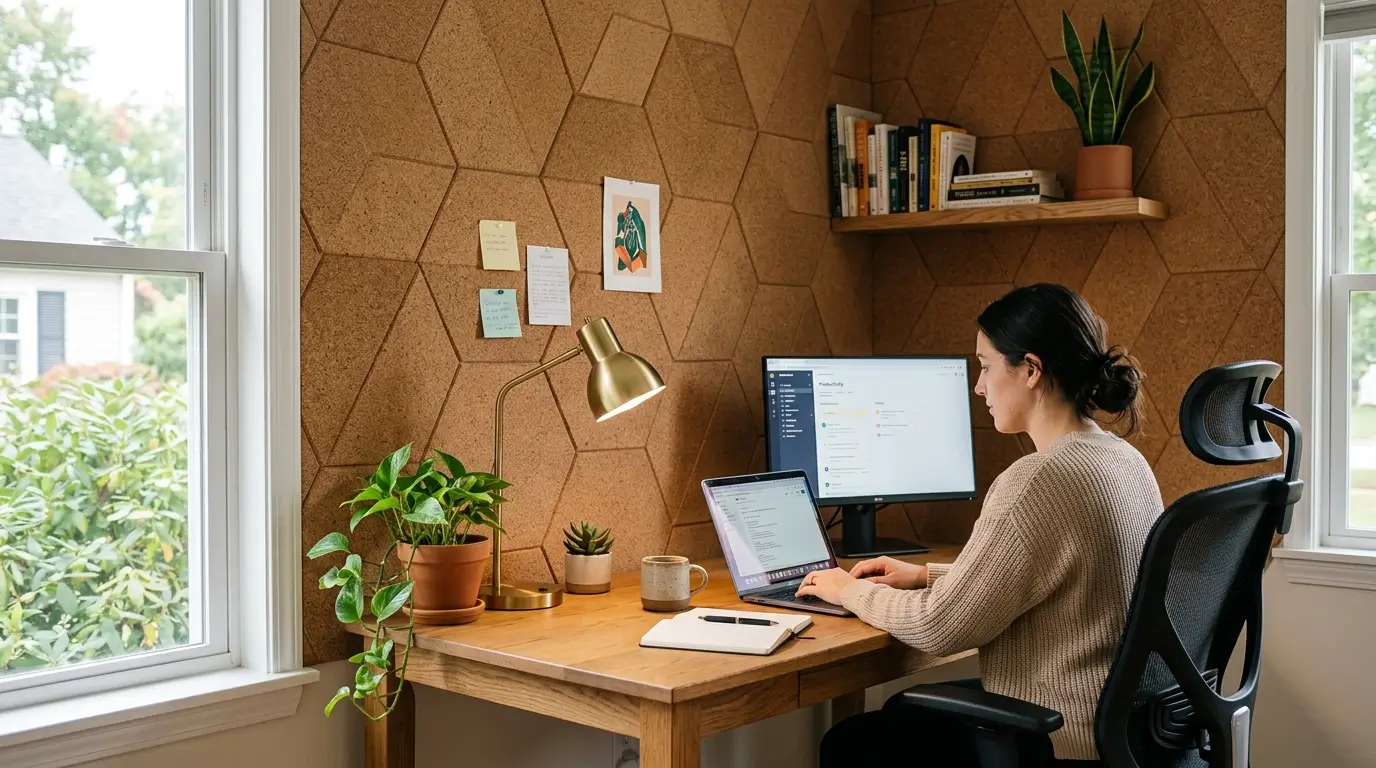
There is a material that has been quietly solving acoustic problems, organizing cluttered workspaces, and adding warmth and texture to interiors for decades, and it receives a fraction of the design attention it deserves. Cork is one of those materials that most people associate with a single specific use — the standard office bulletin board, that slightly apologetic rectangle of beige foam pinned to a wall and covered in overlapping papers — without ever considering what the material is actually capable of when it is approached as a genuine design element rather than a purely functional one.
Cork comes from the bark of the cork oak tree, harvested without cutting the tree down, regenerating fully within a decade, and producing a material that is simultaneously one of the best natural acoustic absorbers available, one of the most thermally insulating natural materials in common use, and one of the most visually warm and texturally interesting surfaces that can be applied to an interior wall. It is naturally antimicrobial, fire resistant, and humidity regulating — properties that make it particularly well suited to the Indian climate where humidity levels during the monsoon season create conditions that cause many wall materials to deteriorate.
In a home office context, cork does something that no other wall treatment quite manages — it solves three distinct problems simultaneously. It absorbs sound, reducing the echo and reverberation that makes video calls sound hollow and concentration difficult. It provides a functional display and pinboard surface that eliminates the need for separate bulletin boards and keeps the workspace visually organized. And it adds a layer of natural material warmth to a space that might otherwise be dominated by the cold, hard surfaces of a desk, a monitor, and the various other pieces of equipment that a working setup requires. The fact that it also looks beautiful when approached with design intention makes it one of the most compelling wall treatment choices available for a home office.
Acoustic Cork Wall Design Ideas for Home Office
1. Full Feature Wall Cork Installation
The most dramatically effective use of cork in a home office is a full feature wall — the wall behind the desk, or the wall that appears in the background of video calls — covered entirely in cork tiles or cork sheet material from floor to ceiling. This installation delivers the maximum acoustic benefit by covering the largest possible surface area with sound-absorbing material, and it creates a visual statement that transforms the home office from a generic workspace into a space with genuine material character and design identity.
A full cork feature wall in its natural warm brown tone creates a backdrop of extraordinary richness. The natural variation in cork’s surface — the subtle pattern of the cellular structure visible across its face, the slight color variation between individual tiles, the way it catches warm light and holds it rather than reflecting it harshly — produces a wall that looks far more sophisticated and intentional than the material’s humble reputation suggests. Against this warm brown backdrop, a monitor on a desk arm, a simple lamp, and a few carefully chosen accessories create a working environment that feels considered and personal rather than assembled from default office furniture.
The acoustic performance of a full cork feature wall is significant enough to make a noticeable difference to the sound quality of a home office. Cork absorbs mid and high frequency sound effectively, which are the frequencies most responsible for the harsh, echo-prone quality of untreated rooms that makes voices sound thin on calls and makes the general noise environment of the room more fatiguing than it needs to be.
2. Cork Tiles in Geometric Patterns
The standard approach to cork wall installation — square tiles aligned in a simple grid — is the most common because it is the easiest, but it is far from the most interesting. Cork tiles installed in herringbone, chevron, diagonal, or more complex geometric arrangements transform the same material into a surface with a strong visual identity that reads as an intentional design feature rather than a utilitarian covering.
A herringbone cork tile installation on the home office feature wall creates a surface that has the visual elegance of a hardwood floor turned vertical — warm, patterned, and deeply traditional in a way that works beautifully in both contemporary and more classically furnished spaces. The direction of the pattern creates a sense of movement and rhythm on the wall that a simple grid completely lacks, and the shadow lines between the angled tiles add a quality of depth that makes the surface more visually interesting at every scale of observation.
Chevron patterns — where the tiles meet at a central point to create a continuous V shape across the wall — create a more formal and architecturally considered effect that works particularly well in a home office with a clean, structured aesthetic. Diagonal tile installations, where standard square tiles are rotated 45 degrees and laid in a diamond grid, produce a surface that feels more dynamic and less predictable than the horizontal-vertical grid and introduces a quality of energy that suits a working environment where alertness and focus are the desired mental states.
3. Mixed Cork and Wood Slat Wall Panel
One of the most sophisticated applications of cork in a home office wall design combines cork panels with vertical or horizontal timber slats in a composition that uses the textural contrast between the two natural materials to create a surface of exceptional visual richness. The warmth of cork and the warmth of wood are complementary rather than competing — both natural, both organic, both carrying the kind of material depth that synthetic surfaces cannot replicate — but their textures are distinctly different in a way that makes the contrast between them visually compelling.
A typical mixed installation might feature a central section of full cork wall flanked on each side by vertical timber slat panels, or alternating horizontal bands of cork tile and timber batten running across the width of the wall. The timber provides a structural visual rhythm that organizes the more amorphous texture of the cork, while the cork provides an acoustic softness and a functional pinboard quality that the timber alone cannot deliver.
In an Indian home office context, dark-stained timber slats against natural cork tiles create a particularly striking combination — the deep, rich color of the wood and the warm honey of the cork together produce a palette that references the traditional material richness of Indian craft interiors while feeling completely contemporary in execution. This combination also photographs beautifully, which matters for anyone who regularly appears on video calls from their home office and wants the background to look as considered as the work being done in front of it.
4. Colored and Painted Cork Tile Designs
Natural cork in its unfinished state is warm and beautiful, but the material also accepts paint and stain readily, which opens up the possibility of cork wall designs that incorporate color without losing the acoustic and textural properties that make cork valuable in a home office. Painting alternate tiles in a contrasting color, creating a pattern of colored and natural tiles, or applying a wash of color over the entire cork surface to shift its tone while preserving its texture are all approaches that add a personal and distinctive quality to a cork wall installation.
A simple checkerboard pattern of natural cork and white-painted cork tiles creates a graphic, high-contrast surface that feels energetic and contemporary without introducing any synthetic materials. A pattern of natural cork tiles with terracotta-painted accent tiles creates a warm, earthy surface that sits naturally within the broader palette of Indian interior design. Deep olive or forest green painted cork tiles mixed with natural ones create a surface that references the biophilic design tendency of 2026 while delivering the acoustic benefits that any cork installation provides.
The painting of cork tiles is straightforward — standard emulsion paint applied with a foam roller adheres well to cork’s open cellular surface and dries to a clean, even finish. The paint does reduce but does not eliminate cork’s acoustic absorption properties, so painted cork tiles remain meaningfully more sound-absorbent than painted plaster or a painted hard wall surface.
5. Cork as a Functional Pinboard Feature
The most obvious functional use of cork in a home office — as a pinboard surface for notes, deadlines, inspiration, and reference material — becomes a genuine design feature when the pinboard is scaled up from the standard small rectangle to a considered section of the wall that has been specifically designed to serve this function. A large, well-proportioned section of cork wall behind or beside the desk, framed by timber battens or a painted border to give it a defined edge and a deliberate appearance, transforms the pinboard function from an afterthought into a central organizational feature of the workspace.
A well-styled cork pinboard wall in a home office is one of the most personally expressive design elements available in any working space. The combination of project notes, inspiration images, photographs, color swatches, deadlines, and motivational material that accumulates on a working pinboard creates a constantly evolving surface that reflects the current state of the work being done and the mind doing it. Unlike a digital organization system that stores everything out of sight, a physical cork wall keeps the most important current material visible and present in a way that consistently supports better creative and organizational thinking.
The framing of the cork pinboard section matters as much as the cork itself from a design perspective. A slim timber frame in a dark stain, or a painted border in a contrasting color, gives the pinboard section a visual boundary that makes it look intentional and finished rather than like a random section of wall that happens to be cork. This detail distinguishes a well-designed cork wall from an improvised one and makes the difference between a home office that looks considered and one that looks provisional.
6. Cork Hexagon Tile Arrangements
Hexagonal cork tiles are one of the most visually dynamic formats in which cork is available for wall installation. The hexagonal shape creates a honeycomb pattern across the wall surface that has an organic, cellular quality that reads immediately as natural — the pattern references the actual cellular structure of cork itself, the honeycomb of beehives, and the geometric patterns found across the natural world from basalt formations to compound eyes. It is a pattern that feels simultaneously mathematical and biological, ordered and organic.
A full wall of hexagonal cork tiles creates a surface of extraordinary visual complexity and textural richness that is simultaneously one of the most effective acoustic treatments available and one of the most distinctive wall designs possible in a home office. Individual hexagons can be installed in a continuous pattern across the entire wall, or arranged in clusters with gaps of painted wall between them for a more open, graphic composition that uses negative space as deliberately as the cork itself.
Hexagonal cork tiles of different natural colors — the variation between darker and lighter cork producing a subtle tonal variation across the installation — create a surface that shifts in color slightly depending on the angle and intensity of the light, which gives the wall a quality of life and responsiveness that single-color flat surfaces completely lack. This tonal variation is entirely natural and requires no additional design input — it is simply the honest expression of the material’s own character.
7. Cork Wall with Integrated Desk and Shelving System
The most comprehensively functional application of cork in a home office is a full wall system that integrates a desk surface, floating shelves, and cork paneling into a single, coherent wall installation. This approach treats the entire work wall as a single designed element rather than a collection of separate furniture pieces and wall treatments, and the result is a home office environment of exceptional organization, functionality, and visual cohesion.
In this configuration the cork does not occupy the entire wall surface — it fills the panels between and around the shelves and desk, providing acoustic treatment and pinboard functionality in the areas where they are most useful while the shelves and desk surface provide the structural and functional elements of the workspace. The integration of all these elements into a single wall composition creates a working environment that feels architecturally resolved rather than assembled from disparate pieces, which is a quality that is difficult to achieve through the purchase of standard furniture alone.
This kind of integrated wall system is ideally suited to custom carpentry, which in Indian cities can be commissioned at reasonable rates that compare favorably with the purchase of equivalent modular furniture from mass-market retailers. A local carpenter working from a clear brief can build a desk, shelving, and cork panel system to the exact dimensions of the wall and the exact requirements of the work being done in front of it, producing a result that fits the space perfectly and serves the user specifically rather than approximating both.
8. Partial Cork Wall with Contrasting Paint
A partial cork installation — a section of the wall covered in cork with the surrounding wall in a complementary paint color — is one of the most accessible and most visually effective ways to introduce cork into a home office without the commitment or cost of a full wall installation. The definition of the cork section by the contrasting paint color on either side gives it a strong visual identity and makes it read as a deliberate design feature rather than an incomplete installation.
The choice of the contrasting paint color is the most important design decision in this approach. A deep, saturated color on the painted sections — forest green, deep navy, charcoal, or warm terracotta — creates a dramatic, high-contrast composition that makes the natural cork appear even warmer and more luminous by comparison. A softer, more tonal approach using a muted warm neutral on the painted sections creates a more restrained and cohesive result that lets the texture of the cork be the primary visual interest rather than the color contrast.
The proportions of the cork section relative to the painted sections matter significantly to the overall visual balance of the wall. A cork panel that is too small in proportion to the painted wall around it looks insignificant and accidental. A cork panel that occupies roughly a third to a half of the total wall area, clearly framed by the painted sections on either side, achieves the kind of visual presence that makes the installation feel confident and intentional.
Choosing the Right Cork Product for Your Home Office Wall
The quality and specification of the cork product chosen for a home office wall installation determines both its acoustic performance and its visual longevity. Cork tiles are available in a range of thicknesses from 3mm to 12mm and beyond, and the thickness directly affects the acoustic absorption — thicker cork absorbs more sound and performs better at lower frequencies. For a home office where the primary acoustic concern is reducing echo and improving call quality, tiles of at least 6mm thickness are recommended. For more significant acoustic treatment where external noise intrusion is the main problem, thicker cork or a double-layer installation delivers better performance.
The surface treatment of the cork is also relevant. Natural unsealed cork has the highest acoustic absorption but is more vulnerable to moisture, staining, and surface damage. Lightly sealed cork with a water-based finish maintains most of its acoustic properties while being more resistant to the humidity and occasional contact with water that is inevitable in everyday use. Heavily lacquered cork loses a significant portion of its acoustic absorption but gains a durable, cleanable surface that works well in high-contact areas.
A Home Office That Works With You
Cork is one of those rare materials that justifies its presence in a home office on multiple grounds simultaneously — acoustic performance, functional utility, visual warmth, environmental sustainability, and design flexibility — without asking for a premium price or a specialized installation process in return. A home office wall treated with cork is a wall that absorbs the sound that makes focus difficult, holds the notes that keep the work organized, and creates the warm, natural backdrop that makes spending eight hours a day in a room a genuinely pleasant experience rather than merely a tolerable one. That combination of benefits, delivered by a material that comes from a tree and returns to the earth at the end of its life, makes cork one of the most complete and most responsible wall treatment choices available for any home office in any home.