Modular Lighting Ideas for Small Living Room Ceiling
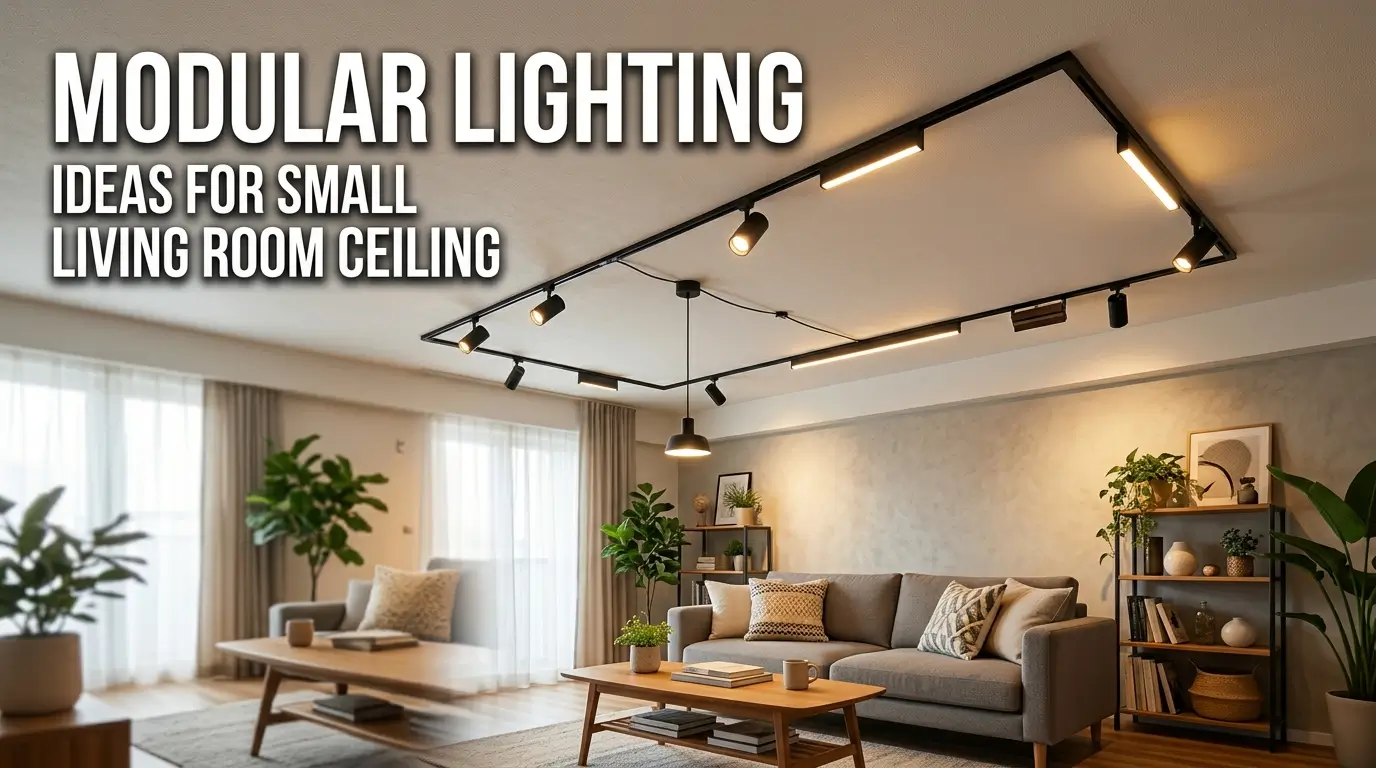
Ceiling lighting in the small Indian living room is one of those design elements that most people set up once and never revisit. A single ceiling rose, a standard batten fixture or a basic chandelier installed by the electrician when the flat was first occupied, doing the job of lighting the entire room from a single point with a single quality of light — flat, even, and completely indifferent to what is actually happening in the space below it. The room is illuminated but it is not lit. There is a significant difference between the two that most people only fully understand the first time they experience a room where the lighting has been genuinely designed rather than merely installed.
The difference between an illuminated room and a lit room is the difference between a space that is functional and a space that is alive. Illumination fills a room with undifferentiated light that treats every surface, every corner, and every activity happening in the space as equivalent. Lighting — real, considered, layered lighting — creates zones of varying intensity and warmth, defines the character of different areas, draws attention to the surfaces and objects worth looking at, and changes with the time of day and the activity of the moment. A lit room feels designed. It feels inhabited. It feels like someone made considered decisions about how it should look and feel at different times and in different conditions.
For a small living room, the quality of ceiling lighting has an outsized impact on the perceived size of the space. A single bright overhead fixture in a small room creates a flat, harsh light that flattens every surface, eliminates shadow and depth, and paradoxically makes the room feel smaller by removing the visual complexity that shadow and varied light intensity create. Modular lighting — a system of multiple smaller light sources distributed across the ceiling and combined with other lighting layers — does the opposite. It creates depth, defines zones, draws the eye around the room rather than compressing it into a single brightly lit plane, and makes a small living room feel considerably more spacious and considerably more atmospheric than a single powerful ceiling fixture ever could.
Modular Lighting Ideas for Small Living Room Ceilings
1. Track Lighting Systems
Track lighting is one of the most versatile and most practically flexible modular ceiling lighting systems available for a small living room, and it is significantly underused in Indian domestic interiors relative to its prevalence in commercial and retail spaces where its advantages are well understood. A single track mounted on the ceiling carries multiple individually adjustable spotlights that can be pointed in different directions — at the TV background wall, at a bookshelf, at the seating area, at a piece of art — creating a multi-directional lighting composition from a single ceiling installation point.
The fundamental advantage of track lighting in a small living room is the ability to direct light precisely where it is needed rather than casting it uniformly across the entire ceiling plane. When the light is directed at the walls rather than down at the floor, it creates a quality of reflected, ambient illumination that makes the room feel larger by visually extending the lit surface area beyond the floor and furniture. Wall washing — the technique of directing a spread of light across a vertical wall surface — is one of the most effective ways to make a small room feel more spacious, and track lighting is one of the most accessible tools for achieving it in a domestic setting.
Modern track lighting systems available in Indian cities include low-voltage LED track heads that run cool, consume minimal electricity, and come in a range of beam angles from narrow spot to wide flood that suit different applications. A narrow spot directed at the TV background wall creates a dramatic accent. A wide flood directed at the seating area creates warm, ambient fill light. The ability to combine both on a single track, and to adjust the balance between them at any time, gives a small living room a lighting flexibility that a fixed ceiling fixture simply cannot provide.
2. Recessed Spotlights in a Considered Grid
Recessed downlights — small, flush-mounted spotlights set into the ceiling surface — are the most architecturally clean modular lighting option available for a small living room because they eliminate the visual presence of the light fitting itself, leaving the ceiling surface uninterrupted by hardware. When distributed across the ceiling in a considered grid arrangement and fitted with warm white LED lamps, recessed downlights create a quality of even ambient illumination that is more flattering and more residential than a single central fixture of equivalent total power.
The positioning of recessed downlights in a small living room ceiling is a decision that significantly affects both the quality of light and the perception of the space. Lights positioned at the perimeter of the room rather than the center, directed toward the walls rather than straight down, create a perimeter wash of warm light that draws the eye to the walls and makes the room feel wider than a centrally positioned arrangement of the same number of lights. Lights over the seating area create intimacy and focus. A single accent light over a side table or a plant creates a small, warm focal point that anchors that corner of the room with a quality of deliberate intention.
The most effective recessed downlight installations in small living rooms use dimmer switches that allow the intensity of the light to be reduced from full task brightness during the day to a much lower, warmer level in the evening. The same ceiling grid of downlights that provides comfortable working illumination during the afternoon becomes soft, intimate mood lighting in the evening simply by adjusting the dimmer — a flexibility that makes the investment in a well-positioned recessed system one of the highest-value lighting decisions available in a small living room.
3. Pendant Clusters and Multi-Drop Arrangements
A cluster of pendant lights hanging at different heights from a single ceiling canopy is one of the most visually dramatic and most spatially effective modular ceiling lighting approaches available for a small living room. Rather than a single large pendant that occupies the center of the ceiling and competes with the room below it, a cluster of smaller pendants at varying drop lengths creates a sculptural light installation that fills the upper portion of the room with visual interest while distributing the light across a wider area and at a more human scale.
The visual effect of a pendant cluster on a small living room ceiling is significant. By filling the vertical space between the ceiling and the eye level of the room’s occupants with a composition of hanging objects — shades, cords, bulbs — the cluster creates the impression of a richer, more layered space than a single central fixture suggests. The pendants draw the eye upward, which has the perceptual effect of making the ceiling feel higher and the room feel larger. And if the ceiling height is genuinely limited, pendants set at varying heights prevent the claustrophobic feeling that a low ceiling can create by breaking up the plane between ceiling and occupied space.
In an Indian living room context, pendant clusters in natural materials — woven rattan shades, bamboo pendants, handblown glass bulbs, terracotta-glazed ceramic pendants — introduce the material warmth and craft quality that defines the best contemporary Indian interiors while providing a genuinely functional lighting installation. Three to five pendants of varying heights and potentially varying shade materials create a composition that looks like a deliberate artistic arrangement rather than a standard lighting fixture.
4. LED Strip Cove Lighting
Cove lighting — LED strip lights installed in a recessed channel or ledge built around the perimeter of the ceiling, directing light upward to reflect off the ceiling surface and back down into the room as soft, diffuse ambient illumination — is one of the most effective and most transformative ceiling lighting techniques available for a small living room. The light it produces has a quality that no direct downlight can replicate: it is completely sourceless from within the room, arriving from the ceiling surface itself rather than from a visible fixture, and its softness and evenness create an atmosphere of effortless calm that makes a small room feel considerably more generous and more comfortable than direct overhead lighting allows.
The installation of cove lighting in a small living room requires the addition of a false ceiling element — a perimeter border of gypsum board or timber that creates the recess within which the LED strips are concealed. This is a cost that should be considered alongside the lighting installation itself, but the combined result justifies that investment comprehensively. A small living room with warm cove lighting has a quality of spatial generosity that visitors consistently notice without necessarily being able to identify its source — which is exactly the quality that the best lighting achieves.
LED strip lights in the 2700 Kelvin range produce the warmest and most residential quality of cove light, avoiding the slightly clinical quality that cooler color temperatures introduce. Dimmable LED strips allow the cove light intensity to be adjusted from full ambient brightness during social occasions to a low, intimate glow during quiet evenings, which makes the cove the workhorse of the room’s lighting system across every activity and every time of day.
5. Magnetic Modular Track Systems
Magnetic track lighting systems represent the most recent and most technically sophisticated evolution of the track lighting concept, and they are particularly well suited to the small living room context where flexibility, minimalism, and the ability to change the lighting configuration without rewiring are all valuable properties. A magnetic track is a slim, flush-mounted or surface-mounted rail that carries electrical current along its entire length, and any compatible lighting module — spotlights, linear bars, pendants, flood lights — can be attached anywhere along the track and removed or repositioned without any tools.
The visual minimalism of a magnetic track system is one of its primary design advantages in a small living room ceiling. The track itself is typically a slim, rectangular section no more than a few centimeters wide, available in black, white, or metallic finishes that sit cleanly against the ceiling surface. The lighting modules clip onto the track magnetically and can be oriented in any direction, creating a completely flexible composition of light directions and intensities that can be reconfigured at any time as the furniture arrangement, the seasons, or the requirements of the space change.
In Indian cities, magnetic track systems are available through specialty lighting retailers and imported lighting brands at price points that reflect their technical sophistication. For a small living room where the quality of the lighting environment significantly affects the daily experience of the space, the investment in a magnetic track system delivers a level of flexibility and visual precision that conventional fixed ceiling installations cannot approach.
6. Statement Ceiling Fan with Integrated Lighting
In the Indian climate context, a ceiling fan is not a luxury but a necessity for the majority of the year, and the standard approach of installing a basic utilitarian fan in the center of the living room ceiling and supplementing it with separate lighting fixtures misses an opportunity to combine both functions in a single installation that serves both purposes with more design sophistication than either a plain fan or a plain light fixture could achieve independently.
Contemporary ceiling fans with integrated LED light kits have evolved significantly beyond the standard fan-light combination of previous decades. Designer fans with wooden or metal blade profiles, brushed brass or matte black motor housings, and integrated warm white LED panels that distribute light evenly across the room are available from Indian fan brands and international brands distributed in India at a wide range of price points. Some designs incorporate multiple individually controlled light zones within the same fan fitting, allowing the central area light to be adjusted independently from a perimeter ambient ring, creating a basic two-layer ceiling light system within a single installation.
The ceiling fan as a design element in the small living room ceiling is an opportunity that Indian interior design is only beginning to explore seriously. A well-chosen designer fan is not a compromise between thermal comfort and design quality — it is a fixture that serves both functions with equal consideration and turns a practical necessity into a design statement.
7. Geometric Linear LED Arrangements
Linear LED fixtures — slim, rectangular light bars that project very little from the ceiling surface — can be arranged in geometric patterns on the ceiling to create a modular light installation that is simultaneously a ceiling design feature and a functional lighting system. The geometric arrangement of the linear bars creates a visual composition on the ceiling that fills the upper plane of the room with a pattern of light and form, making the ceiling itself a design element rather than a blank surface that the lighting merely interrupts.
A simple arrangement of three parallel linear bars across the length of the small living room ceiling creates a clean, ordered light composition that provides even ambient illumination while introducing a linear visual rhythm to the ceiling plane. A more complex arrangement of perpendicular linear bars in a grid creates a composition that references the coffered ceiling tradition of classical architecture in a completely contemporary form. An asymmetric arrangement of linear bars at different lengths and positions creates a more dynamic, less formal ceiling composition that suits a living room with a similar energy in its furniture and accessory choices.
Linear LED fixtures available in the Indian market range from basic batten replacements to premium architectural linear systems with continuous dimming, color temperature adjustment, and sophisticated mounting hardware. The choice should be calibrated to the overall design investment being made in the room — a premium linear system in a room with basic furniture creates a visual mismatch that reads as poorly considered, while a well-chosen mid-range system in a consistently designed room creates the kind of cohesive design quality that makes a space feel genuinely resolved.
8. Combination Ceiling with Multiple Levels
A false ceiling designed with multiple levels — a central recessed section at standard ceiling height, a perimeter border dropped slightly lower, or a central dropped section that creates an intimate canopy over the seating area — creates the most architecturally complex and most spatially sophisticated ceiling treatment available for a small living room, and it is also the one that most directly amplifies the effectiveness of every other lighting strategy on this list.
A multi-level false ceiling creates natural locations for different types of modular lighting at different heights. Cove lighting in the perimeter border. Recessed spotlights in the central section. A pendant or fan fitting at the lowest dropped section over the seating area. This vertical distribution of light sources creates a lighting composition of remarkable depth and richness that a flat ceiling with the same number of fixtures cannot replicate, because the variety of heights from which the light originates prevents any single direction of illumination from dominating.
For a small living room where the ceiling treatment represents a significant investment in both cost and visual impact, a multi-level false ceiling with integrated modular lighting is the highest-performing option available. The ceiling becomes as much a design feature as the walls and the floor, and the lighting embedded within it creates an environment of genuine quality that justifies every rupee of the investment through the daily improvement in the experience of being in the space.
Combining Modular Ceiling Lighting with Other Layers
The modular ceiling lighting ideas described in this list perform best not in isolation but in combination with floor lamps, table lamps, wall sconces, and accent lights that operate independently and supplement the ceiling system with light at lower levels. A ceiling system that provides ambient illumination combined with floor lamps that create warm pools of light in the corners of the room, a table lamp on a side table beside the sofa, and perhaps a small accent light on a shelf or bookcase creates a fully layered lighting environment of the kind that professional interior designers describe as the difference between lighting a room and designing its atmosphere.
The control of this layered system through separate switches, dimmers, and increasingly through smart home platforms that allow different lighting scenes to be recalled with a single command or a voice instruction is the final element that makes a well-designed modular lighting system genuinely transformative in daily use. The ability to shift from bright, evenly lit social mode to soft, intimate evening mode to task-focused working mode without changing a single physical element of the room — simply by adjusting the lighting — is one of the most practically impactful design capabilities available in any small living room.
Light as the Room’s Most Powerful Design Tool
Modular ceiling lighting in a small living room is not primarily a technical or practical question. It is a design question about how the room should feel at different times, in different conditions, and for different activities. The ceiling is the largest unobstructed surface in any room and the one that most directly determines the quality of light throughout the space. When it is treated as a design surface rather than a functional installation, when the lighting it carries is distributed, varied, warm, and responsive to the life being lived below it, a small living room becomes a space of genuine atmospheric quality that its dimensions alone could never suggest. That transformation is what good lighting does, and it is available to every small living room in every Indian home through the application of the modular principles described in this list.