Vertical Storage Ideas for Very Small Kitchen in India
The kitchen is the hardest-working room in any Indian home. It produces three meals a day, handles the complexity of a cuisine that involves more vessels, more spices, more ingredients, and more equipment than almost any other culinary tradition in the world, and it does all of this in a space that in most urban Indian apartments is barely large enough to turn around in comfortably. A small kitchen in an Indian flat is not just a spatial challenge — it is a logistical one, and the gap between a kitchen that works smoothly and one that feels like a daily battle is almost always a storage problem rather than a size problem.
The instinct when dealing with a small kitchen is to look for more counter space or more cabinet space, both of which usually require renovation, expense, and in a rental situation, landlord approval that may never come. But the most effective solution to a small Indian kitchen’s storage problem is almost never horizontal — it is vertical. The walls, the space above the cabinets, the area between the counter and the ceiling, and even the ceiling itself represent a significant amount of untapped storage capacity that most small kitchens leave completely unused while their countertops drown in vessels, appliances, and ingredients that have nowhere else to go.
Going vertical in a small Indian kitchen doesn’t require a renovation. It requires wall hooks, rails, shelves, and a willingness to think about the kitchen’s walls as storage surfaces rather than blank backgrounds. The transformation that a well-executed vertical storage strategy delivers to a small Indian kitchen is one of the most dramatic and cost-effective improvements available in any home.
Vertical Storage Ideas for a Very Small Kitchen in India
1. Wall-Mounted Spice Racks
Spices are the defining storage challenge of an Indian kitchen. A standard Indian household maintains anywhere from twenty to fifty spice varieties at any given time, and finding a storage solution that keeps them organized, accessible, and off the counter is one of the most meaningful improvements you can make to a small kitchen’s functionality.
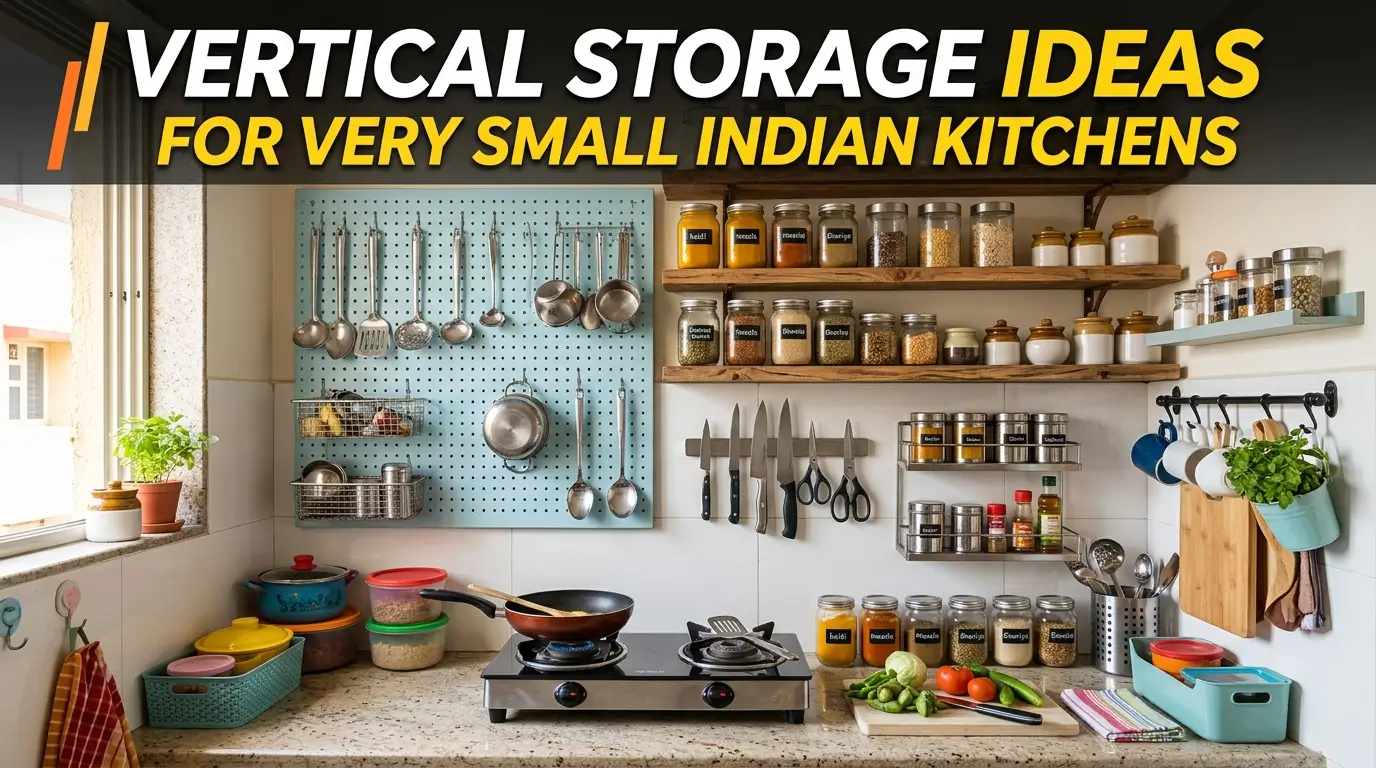
Wall-mounted spice racks solve this problem by moving the entire spice collection off the counter and onto the wall. A tiered wall-mounted rack installed between the counter and the upper cabinets, or on a section of wall beside the stove, holds a large number of spice containers in a single compact installation that takes up no counter space at all. Magnetic spice containers that attach directly to a magnetic strip mounted on the wall are an even more compact variation of this idea, holding the spice containers flat against the wall surface and making the collection visible and accessible in a single glance.
In an Indian kitchen where the spice collection is both large and frequently accessed, having it mounted on the wall at eye level and arm’s reach from the cooking area is not just a storage improvement — it is a workflow improvement that makes everyday cooking noticeably faster and more organized.
2. Pegboards for Flexible Wall Storage
A pegboard installed on one wall of a small Indian kitchen is one of the most versatile and cost-effective vertical storage solutions available. It is a sheet of perforated board — available from hardware stores across India at very accessible prices — onto which hooks, shelves, bins, and holders of various kinds can be attached in any configuration and rearranged at any time as needs change.
On a kitchen pegboard, pots and pans hang from large S-hooks, freeing the cabinets they would otherwise occupy for items that cannot be hung. Ladles, spatulas, and other long-handled utensils hang from smaller hooks in a row, removing them from the counter caddy and the drawer jumble simultaneously. Small bins hold onions, garlic, ginger, and other everyday ingredients that would otherwise take up counter space. A small shelf bracket holds a cookbook or a tablet at eye level for following recipes.
The flexibility of a pegboard is its greatest strength in an Indian kitchen context where storage needs change with the seasons, with the size of the household, and with the evolving collection of vessels and appliances that accumulates over time. Nothing about the arrangement is permanent, and everything can be adjusted without any tools or any damage to the wall.
3. Hanging Pot Rails and Ceiling Hooks
Pots, pans, pressure cookers, and kadais are among the bulkiest items in any Indian kitchen and among the most difficult to store efficiently in limited cabinet space. A hanging pot rail mounted on the wall or suspended from the ceiling moves these items completely out of the cabinets and into the overhead space where they are both stored and displayed simultaneously.
A wall-mounted rail with S-hooks installed above the counter or beside the stove holds a full collection of pots and pans in a row that is visually organized and immediately accessible during cooking. A ceiling-mounted rail suspended on adjustable chains works particularly well in kitchens with higher ceilings, holding the heaviest and largest vessels overhead where they are completely out of the way during food preparation but easy to reach when needed.
In an Indian kitchen context where the pressure cooker alone comes in multiple sizes and the kadai collection tends to grow steadily over the years, freeing the cabinet space occupied by these vessels creates an immediate and significant improvement in overall kitchen storage capacity. The items that were crowding out everything else in the cabinets now hang overhead, and the cabinet space they occupied becomes available for the dozens of other things that previously had nowhere to live.
4. Stacked Wall Shelves Between Counter and Cabinets
The space between the kitchen counter and the upper wall cabinets — typically called the backsplash zone — is one of the most consistently underused vertical areas in an Indian kitchen. It is too narrow for additional cabinets but perfectly suited for a series of slim wall-mounted shelves that hold a surprising amount without projecting far enough from the wall to interfere with counter work.
Slim floating shelves installed in this zone at varying heights hold everyday items like oil bottles, vinegar, sauces, frequently used spices, a small plant, and kitchen tools that need to be within arm’s reach at all times. The items that previously crowded the counter now live on the wall just above it, keeping the work surface clear while keeping everything equally accessible.
In an Indian kitchen where the counter is the primary work surface for chopping, rolling, and assembling food, keeping it clear is not just an aesthetic preference — it is a functional necessity. Every item moved from the counter to a wall shelf above it directly increases the usable work area, which in a very small kitchen can make the difference between a comfortable cooking experience and a frustrating one.
5. Over-Door Storage Systems
The inside of kitchen cabinet doors and the back of the kitchen entry door are two of the most overlooked storage surfaces in a small Indian kitchen. Both can be fitted with over-door organizers, hook rails, and pocket systems that add significant storage capacity without occupying any floor or wall space at all.
An over-door organizer on the inside of a tall cabinet or pantry door holds spice packets, oil sachets, snack items, cleaning supplies, and small kitchen tools in a series of pockets or wire baskets that are completely invisible when the door is closed. On the inside of upper cabinet doors, small magnetic strips or adhesive hook systems hold measuring spoons, small tools, and jar lids in a way that keeps them organized and accessible without taking up any shelf space inside the cabinet.
On the back of the kitchen entry door, a tall over-door rack can hold everything from cleaning supplies and mop handles to extra vessels, a small ironing board, or a collection of reusable shopping bags — items that have no logical home inside the kitchen itself but need to be nearby and accessible without cluttering the main kitchen space.
6. Magnetic Knife Strips and Tool Rails
A knife block on the counter is one of the most space-inefficient ways to store knives in a small Indian kitchen. It occupies a footprint that the counter simply cannot spare and holds the knives in a configuration that makes them difficult to see and select quickly during cooking. A magnetic knife strip mounted on the wall holds the same collection of knives flat against the wall surface, taking up no counter space at all and making every knife instantly visible and accessible.
The same principle applies to kitchen scissors, peelers, and other small tools that typically live in a cluttered drawer. A wall-mounted tool rail with individual hooks holds these items organized and visible on the wall, eliminating the drawer jumble that makes finding the right tool a minor but consistently frustrating daily experience. In a very small Indian kitchen where every drawer is already full and every counter inch is contested, moving knives and tools to the wall is one of the simplest and most immediately satisfying vertical storage upgrades available.
7. Tiered Corner Shelves
The corners of a small Indian kitchen are almost always wasted space. Standard cabinets and shelves meet at corners and leave a triangular area that is technically inside the cabinet but practically inaccessible because nothing can be stored there without blocking everything else. Open tiered corner shelves replace this dead space with a display and storage solution that makes corner areas not just usable but genuinely attractive.
A set of tiered floating corner shelves installed in the corner between two walls, running from counter height up toward the ceiling, creates a vertical storage column that holds a large number of items in a compact footprint. Frequently used vessels on the lower shelves, less frequently used items on the upper ones, and decorative elements like small plants and ceramic canisters mixed in throughout make the corner shelves a functional and visually appealing feature of the kitchen rather than a problem area that the eye tends to avoid.
8. Tall Pantry Units Instead of Low Cabinets
In a small Indian kitchen where the floor plan cannot be expanded, the most effective way to increase total storage volume is to use the full height of the room rather than stopping storage at eye level. A tall, narrow pantry unit that extends from floor to ceiling stores significantly more than a low cabinet of the same footprint because it uses the full vertical dimension of the room rather than wasting everything above eye level.
A floor-to-ceiling pantry column beside the refrigerator or along a narrow section of wall that doesn’t accommodate a full counter run creates a dedicated storage zone for dry goods, oils, cereals, packaged foods, and the various other pantry items that typically end up stacked chaotically on whatever surface is available. The upper shelves hold items used less frequently, the middle shelves hold everyday staples at easy reach, and the lower shelves hold heavy items like large oil cans, bulk rice and dal bags, and extra vessels that are used occasionally rather than daily.
9. Under-Shelf Hanging Baskets
The space beneath each shelf inside a cabinet is another consistently overlooked vertical storage resource. Under-shelf hanging baskets — wire or plastic baskets that clip or slide onto the shelf above and hang down into the space below — effectively add an extra storage tier to every shelf in the kitchen without requiring any installation or any modification to the existing cabinet structure.
In an Indian kitchen context, under-shelf baskets are particularly useful for storing lightweight items like plastic bags, paper napkins, foil rolls, small packets of dry goods, and other items that tend to get lost or stack inefficiently on flat shelves. By hanging them below an existing shelf rather than stacking them on top of one, you use the full height of each cabinet compartment rather than leaving the upper portion of each shelf space empty above a pile of items that doesn’t reach the shelf above it.
10. Label and Organize Vertically Stored Items
This final idea is less about adding new storage and more about making the vertical storage you already have or are planning to add actually work in practice. The fundamental challenge of vertical storage — particularly for the upper shelves and overhead areas that are harder to see into — is that items stored out of easy sightline tend to be forgotten, leading to duplicate purchases and the gradual accumulation of expired goods that nobody knew were there.
Clear containers, consistent labeling, and a logical organization system that puts the most frequently used items at the most accessible heights and the least frequently used items at the highest and lowest points is the difference between a vertical storage system that works smoothly and one that looks organized but functions chaotically. In an Indian kitchen where the ingredient inventory is large and varied, this organizational discipline is as important as the physical storage infrastructure itself.
Combining Vertical Storage Strategies for Maximum Impact
The most important principle to understand about vertical storage in a very small Indian kitchen is that no single solution works in isolation. A pegboard on one wall, a spice rack on another, hanging pots overhead, under-shelf baskets in the cabinets, and a tall pantry column in one corner — these solutions work together as a system, each one addressing a different category of storage need and collectively transforming the total storage capacity and organizational clarity of the kitchen far beyond what any single intervention could achieve alone.
The sequence in which you implement these changes matters too. Start with the changes that free up the most counter space first — the spice rack, the hanging pot rail, and the wall-mounted knife strip — because clear counter space immediately makes the kitchen feel and function better and motivates the next round of improvements. Then address the cabinet organization and the upper wall space. Then refine and adjust based on how the kitchen actually functions with the changes in place.
A Small Kitchen That Works as Hard as You Need It To
A very small Indian kitchen that has been organized vertically is a fundamentally different experience from one that hasn’t. The counters are clear, the walls are working, the overhead space is useful, and the cabinet interiors are organized rather than chaotic. Cooking feels easier, cleaning feels faster, and the kitchen feels larger than its dimensions actually allow because the visual clutter that made it feel cramped has been lifted off the horizontal surfaces and distributed across the vertical ones.
The investment required to achieve this transformation is modest. Most of the solutions described here involve wall hooks, rails, shelves, and organizers that cost very little and require no professional installation. The return on that modest investment — in daily convenience, in cooking ease, and in the simple satisfaction of a kitchen that feels under control rather than overwhelmed — is one of the highest available anywhere in the home.